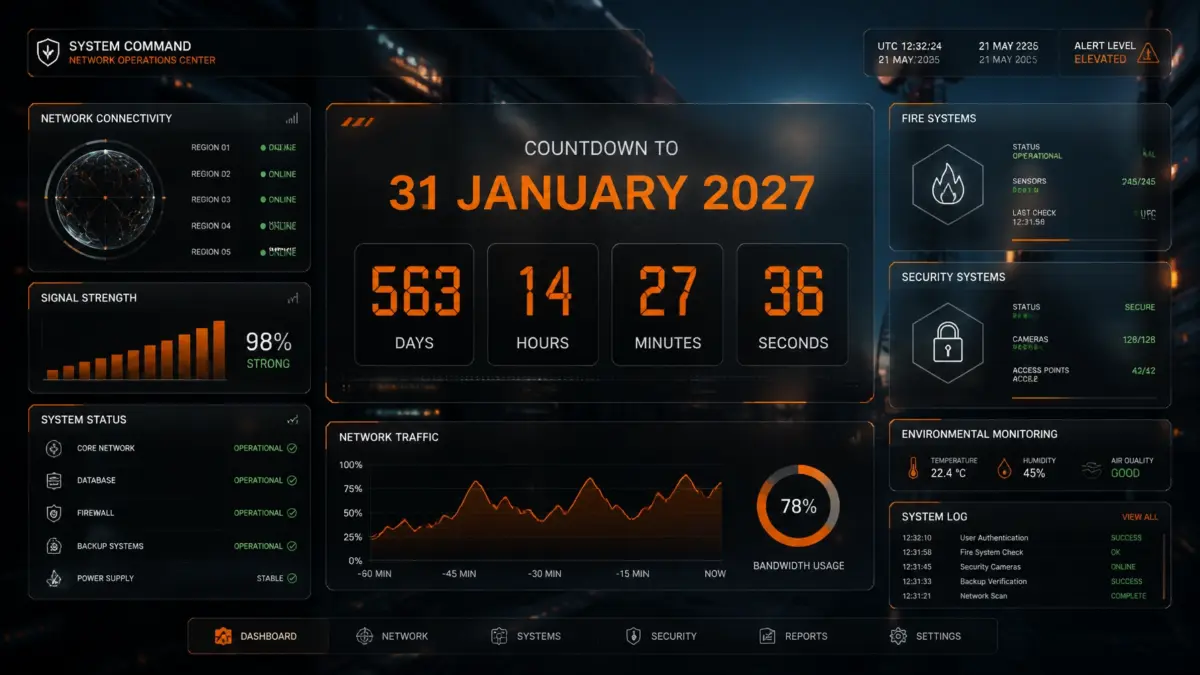
If you’re still installing analogue diallers or relying on legacy PSTN lines for your clients' monitoring, you’re on a collision course with a hard deadline.
The UK’s Public Switched Telephone Network (PSTN) is being retired. By 31 January 2027, every traditional copper phone line in the country will be dead. This isn't just a minor upgrade for home broadband; it’s a fundamental shift in how fire and security systems communicate.
For security installers, this is the biggest operational challenge: and commercial opportunity: since the move from tape to digital recording. If you haven’t started auditing your sites and migrating hardware, you’re already behind the curve.
The Reality of the Shutdown
BT and Openreach are moving the entire country to an all-IP network. The old "dial-up" infrastructure that powered alarm signalling for decades is being ripped out.
Many installers think they have until 2027 to worry about this. They’re wrong. Openreach is already implementing "stop-sell" orders in exchanges across the UK. Once an exchange reaches 75% fibre availability, you can no longer order new analogue lines or make changes to existing ones.
The shutdown is happening region by region. Waiting until January 2027 to swap out your clients' hardware is a recipe for disaster. You’ll be fighting for stock, battling engineer shortages, and dealing with "silent failures" where systems appear active but can’t actually signal to the Alarm Receiving Centre (ARC).
What’s at Risk?
Anything that relies on a PSTN or ISDN line is on the chopping block. In our industry, that includes:
- Intruder Alarms: Digital communicators, STUs, and diallers.
- Fire Alarms: Redcare and other monitored signalling paths.
- Social Alarms / Panic Buttons: Vital for elderly or high-risk sites.
- Lift Lines: Emergency call systems that often sit forgotten in a shaft for years.
- CCTV: Legacy systems using PSTN for remote access or telemetry.
When the line goes digital, the voltage changes. The DTMF tones your legacy diallers use to "talk" to the ARC will likely be compressed or distorted by VoIP routers, causing intermittent signalling or total failure.

Why "Digital Lines" From ISPs Aren't Enough
Broadband providers will tell your customers they can just plug their existing phone into their new router. That’s fine for making a brew and calling the grandkids. It’s not fine for life-critical security monitoring.
Consumer-grade VoIP lines lack the reliability needed for security. They don't have the same power resilience as the old copper network. If the power goes out at the site, the router dies, and the alarm signalling dies with it. Unless you’ve installed a robust, battery-backed IP or 4G solution, you’re leaving your clients unprotected.
This is where VoIP Guardian comes in. We didn't build it to be just another phone system; we built it to solve the specific headaches of the fire and security sector.
The Migration Strategy: Audit, Notify, Upgrade
You need to stop thinking about this as a technical problem and start seeing it as a maintenance priority.
1. The Site Audit
Every maintenance visit between now and 2027 should include a signalling audit.
- What is the primary path?
- Is there a PSTN backup?
- Is the communicator compatible with all-IP?
- Is there a 4G/5G failover?
2. Communicate Early
Don't wait for the line to go dead to tell your client they need a hardware upgrade. Send a formal notification now. Explain the risk to their insurance compliance. If an intruder alarm fails to signal during a break-in because the line was switched off, the insurer will likely walk away from the claim.
3. Sell the Upgrade
This is an opportunity to move clients onto more reliable, dual-path signalling. Upgrading to a modern IP-based system with 4G backup provides better security and often reduces long-term line rental costs for the client.

Technical Hurdles: DTMF and Latency
In the analogue world, DTMF (Dual Tone Multi-Frequency) was king. In the VoIP world, it’s a liability. VoIP uses codecs to compress audio data to save bandwidth. These codecs (like G.729) are designed for human speech, not the precise tones used by alarm communicators.
When an alarm panel tries to "handshake" with the ARC over a standard VoIP line, the tones often get clipped. The result? The ARC never gets the signal, or it gets a corrupted one.
To solve this, you need hardware that understands these protocols or bypasses the "audio" path entirely in favour of pure data signalling. Our hardware solutions, like the connected orange units found in the Engineer M8 ecosystem, are designed to handle these transitions without the "silent failure" risk.
Total System Health: Beyond the Phone Line
The 2027 switch-off is just one piece of the puzzle. If you're upgrading the phone system, look at the rest of the site.
- Surveillance Integrity: Are your CCTV systems checking their own health? Surveillance Guardian can check your complete system every 5 minutes and verify image quality with AI.
- Compliance Logging: If you're still using paper logbooks for fire safety, you're missing a trick. FireLog 365 digitises the entire process with NFC inspections.
By bundling the PSTN migration with these modern tools, you aren't just "fixing" a phone line problem: you're modernising the client's entire security infrastructure.
Call Recording and Compliance
As you move your own office and your engineers to VoIP, remember that the rules have changed. For security companies, keeping a record of what was said during an incident report or a service call is vital for liability protection.
Our VoIP Guardian system includes integrated call history and routing. It allows your engineers to make outbound calls using your main office number. This stops customers from calling engineers' personal mobiles directly: a massive headache for scheduling and staff privacy. It also ensures all business communication is logged and professional.

Don't Be the Guy Who Waits
The industry is already seeing a surge in demand for IP signalling hardware. Lead times will increase as the deadline approaches. Price gouging from some suppliers is inevitable as the panic sets in during late 2026.
Secure your hardware now. Educate your customers today.
At Engineer M8, we’ve built the ecosystem to help you manage this transition. From EM8 Core for your job management to VoIP Guardian for your connectivity, we’re providing the tools to make sure security installers aren't left in the dark when the copper lines go cold.
Stop viewing the 2027 switch-off as a threat. Treat it as the catalyst to move your business: and your clients: into the digital age.
Learn more about VoIP Guardian and secure your connectivity today.