Choosing fleet management software in the UK is not a small admin decision. Get it wrong and you end up with weak tracking, patchy compliance records, more phone calls to drivers, and less confidence when the DVSA starts asking questions. Get it right and you cut paperwork, tighten driver accountability, and make better decisions in real time. This guide is a UK-focused comparison for businesses working out what actually matters when choosing fleet management software, from tracking speed to DVLA-linked compliance and day-to-day usability. With DVSA enforcement activity still putting vehicle condition, drivers’ hours, and operator responsibilities under the spotlight, the cost of a poor system is not theoretical. It shows up in downtime, missed defects, failed audits, and avoidable risk.
1. Understanding Your Fleet's Unique Needs
Not every fleet runs the same, so the software should not be expected to. A five-van fire and security business has very different priorities to a national service fleet, a courier operation, or a mixed commercial vehicle setup with cars, vans, and specialist units. Some businesses need tight proof of attendance and engineer visibility. Others care more about licence checks, utilisation, route efficiency, defect reporting, or incident logging.
That is why a one-size-fits-all approach usually falls apart in practice. A basic tracker might be cheap, but it can leave gaps in compliance and reporting. An enterprise platform might have every bell and whistle, but if your team only needs practical visibility, mobile inspections, and solid UK database integration, you end up paying for complexity you will never use. The better approach is to map the software against how your fleet actually operates: vehicle count, driver count, risk profile, industry obligations, and how much admin you are trying to take out of the day.
2. Real-Time Tracking — The 10-Second Standard
A live map is only useful if it is actually live. Refresh rate matters more than most providers admit. If your platform only updates every 30, 60, or even 90 seconds, you are not looking at a real-time operational tool. You are looking at delayed information dressed up as visibility.
For dispatch, lone worker awareness, theft response, engineer arrival confirmation, and customer updates, those delays stack up fast. That is why we benchmark against a 10-second standard. It gives the office a much clearer picture of where vehicles really are and what is happening on the road right now, not a minute ago. Plenty of competitors still operate on slower refresh intervals, especially lower-cost GPS products and some larger systems configured to prioritise battery life or data usage over live visibility. If real-time matters to your operation, ask the question directly: how often does the vehicle position actually update in normal daily use?
3. Automated DVLA Compliance — The Non-Negotiable
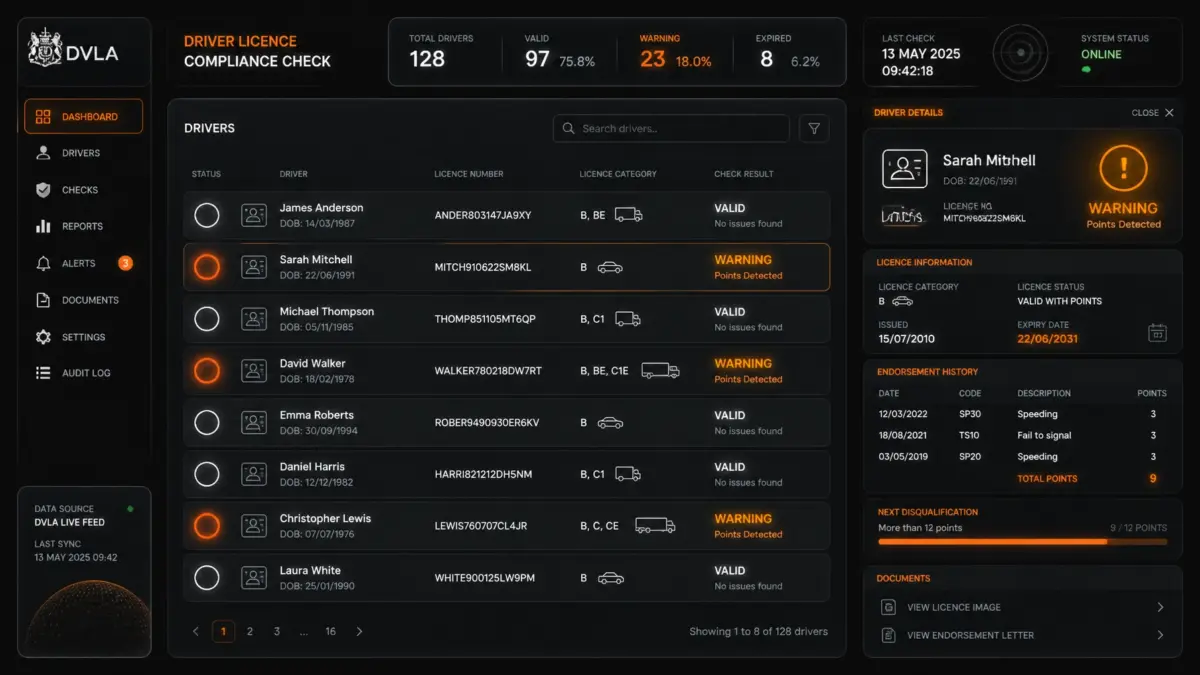
For UK fleet operators, driver licence checking is not an optional admin task. It is a compliance control. If you are relying on manual checks, emailed reminders, or someone remembering to review photocards every few months, there is a real risk that an expired entitlement, a disqualification, or a points issue slips through unnoticed.
That matters because the problem usually only shows up when something has already gone wrong. A roadside stop, an incident, an insurance query, or an audit can quickly expose weak licence monitoring. Automated checks reduce that gap. With Tracking Guardian, driver licence status updates are pulled directly through DVLA integration, so operators get an up-to-date view without building the whole process around spreadsheets and calendar prompts.
It is also worth looking closely at how providers handle this. Native DVLA integration is not the same as a third-party bolt-on. A built-in connection usually means cleaner workflows, fewer sync issues, and less dependence on separate logins or disconnected reports. Bolt-ons can still tick a feature box, but they often add friction. For something as important as driver compliance, that extra layer matters.
4. Vehicle Information Straight from the DVLA
Good fleet software should not stop at tracking dots on a map. It should also give you direct access to the vehicle data you need to run the fleet properly. In the UK, that includes tax status, MOT history, and core vehicle details pulled from government-linked data sources.
The practical benefit is simple. Instead of checking individual registration numbers one by one on the GOV.UK website, your team can see the key information in one dashboard alongside the rest of the fleet record. That saves time, cuts admin, and makes it easier to spot issues before they become problems, whether that is an MOT deadline creeping up, a tax status concern, or a mismatch in vehicle records.
For busy operators, that visibility helps with both compliance and planning. You can schedule work, keep records cleaner, and avoid chasing information across multiple systems. It is not flashy, but it is the kind of operational detail that makes day-to-day fleet management more controlled and far less reactive.
5. Driver Behaviour: Coaching, Not Spying
Nobody likes a "spy in the cab." But everyone likes lower insurance premiums and better fuel efficiency. The best fleet management software doesn't just record "harsh braking"; it provides context.
Look for a platform that uses a Fleet Scorecard. This turns raw data into a leaderboard, encouraging healthy competition among your team. It’s about identifying the 5% of drivers who put your reputation at risk and rewarding the 95% who drive like professionals.
In our ecosystem, we’re integrating Cortex AI to deliver plain-English driver coaching reports. Instead of a spreadsheet of numbers, you get a summary: "Driver A is consistently idling for 20 minutes at the start of the shift." That’s a conversation you can actually have.
6. Digital Vehicle Inspections & The "EM8 HQ" Edge
Paper walkaround sheets are a relic of the past. They get lost, they get coffee spilled on them, and they’re often filled out retrospectively (the "pencil-whipping" effect).
Your choice of software should include a robust mobile app. Our EM8 HQ app allows engineers to complete their daily vehicle checks directly on their phone. If there’s a defect: say, a cracked mirror or a balding tyre: it’s logged instantly, a photo is attached, and the office is alerted.
This isn't just about maintenance; it’s about the Duty of Care. Having a digital audit trail of every check performed ensures you’re "audit-ready" if the DVSA ever comes knocking.
7. Comparing the Market: At a Glance
| Feature | Tracking Guardian | Enterprise Systems (Samsara/Verizon) | Budget GPS Trackers |
|---|---|---|---|
| Refresh Rate | 10 Seconds | 15-60 Seconds | 60+ Seconds |
| DVLA Integration | Native & Automated | Often Third-Party | Rarely Included |
| Development | In-house (UK Based) | US-Based / Global | Outsourced |
| Cost | From £14.99/mo | £20+ /mo | £5-£10/mo |
| Hardware | Secure 4G Units | Proprietary | Varies |
8. Hardware Matters: The Engine Under the Hood
Software is only as good as the data it receives. We’ve seen too many cheap OBD-II trackers that fall out or lose signal in remote areas. For professional fleets, you need hardwired units or high-gain 4G hardware.
Our proprietary hardware units, like those used for Surveillance Guardian, are built to last in demanding environments. When you pair this with our KeySim 4G connectivity, you get a system that doesn't just work: it stays connected.

9. Beyond the Map: A Connected Ecosystem
For fire and security contractors, fleet management is just one piece of the puzzle. You’re also managing Digital Fire Logbooks, CCTV health checks, and Job Management.
The biggest mistake you can make is choosing a fleet system that sits in a silo. You want a platform where your vehicle data talks to your job management. If an engineer arrives at a site, the system should automatically "tag" that visit to the portal job. That’s the level of automation we’re building with Tracking Guardian.
The Verdict: How to Choose?
If you have a 500-vehicle global fleet, the massive enterprise players like Verizon Connect or Samsara might be your go-to. They have the scale, even if they lack the personal touch.
However, if you're a UK-based contractor with 5 to 100 vehicles and you're tired of being just another ticket number, you need a partner, not just a provider. You need a system that:
- Refreshes in 10 seconds, not minutes.
- Automates compliance with the DVLA.
- Removes the paperwork with a native mobile app.
- Integrates with your wider security and fire operations.
Stop chasing paper and start seeing your fleet in real-time.
Ready to see what 10-second tracking actually looks like?
Book a free live demo with our team or explore our pricing plans to see how we can get your fleet back on track.