"He said it was included." "She told me Tuesday was fine." "I’m sure he quoted £450, not £650."
If you’ve run a van, a sparky firm, or a security installation business for more than five minutes, you’ve heard these lines. In the trades, a verbal agreement is often the foundation of a job, but when things go south, it’s your word against theirs. This is why call recording has moved from a "nice-to-have" for big call centers to a critical tool for every local firm.
But as we move into 2026, the legal goalposts have shifted. Between the ICO’s updated guidance, the 2027 analogue switch-off, and the rise of AI-assisted notes, just hitting "record" isn't enough. You need to know the rules, or your evidence won't just be useless, it could be a liability.
The 2026 Landscape: Why "Wait and See" is a Risk
The UK’s communication infrastructure is undergoing its biggest shake-up in decades. Openreach is retiring the analogue phone network in January 2027. For trades businesses still clinging to traditional landlines, the clock is ticking.

Moving to a digital service like VoIP Guardian isn't just about avoiding a dead line in 2027; it’s about gaining the ability to record, transcribe, and audit every conversation your team has. However, with this power comes the weight of UK law, specifically UK GDPR, the Data Protection Act 2018, and Ofcom’s latest regulations.
Can You Lawfully Record Calls in the UK?
The short answer is yes. The slightly longer answer is yes, provided you have a lawful basis.
In 2026, you don't necessarily need explicit, "press 1 to agree" consent for every single call, provided you are recording for specific business reasons. Under the Telecommunications (Lawful Business Practice) Regulations 2000, businesses can record without consent to:
- Provide evidence of a business transaction (a quote, an agreement, a site visit time).
- Ensure regulatory compliance (essential for security installers).
- Maintain quality standards and staff training.
- Prevent or detect crime.
However, these regulations don't give you a free pass to ignore GDPR. You still need to identify a "Lawful Basis" for processing that data.
The "Legitimate Interest" Route
For most trades, "Legitimate Interest" is the strongest path. This means you record because it’s necessary for your business to function: to resolve disputes, train staff, or keep accurate records of jobs.
To stay on the right side of the ICO in 2026, you should have a documented Legitimate Interest Assessment (LIA). It sounds like boardroom fluff, but it’s just a simple document stating why you record, why it’s necessary, and how you protect the caller's rights. If a customer ever challenges a recording, that LIA is your shield.
Transparency: The Non-Negotiable Rule
You cannot record in secret. This is where many small firms get caught out. Whether it’s an inbound call to the office or an engineer calling a client from the site, the caller must be informed that recording is taking place.
A simple pre-call announcement like "This call may be recorded for training and quality purposes" is the industry standard. But in 2026, if you are using AI to transcribe or summarize those calls: features now standard in field service management software: you must be even more transparent. The ICO now expects businesses to disclose AI-assisted analysis if it's being used to make decisions about a customer.

Storing the Data: From Audio Files to Liabilities
Once you’ve recorded a call, that audio file is "Personal Data." You are now a Data Controller. This means you have three main responsibilities:
- Security: You can't just leave MP3 files in a shared Dropbox folder. Recordings must be encrypted and access-controlled. If an engineer can listen to a recording of a sensitive domestic dispute they weren't involved in, you’ve got a compliance breach.
- Retention: You cannot keep recordings forever. You need a policy. For general quotes, maybe six months is enough. For security company software users handling high-risk installations, you might need years to satisfy insurance or regulatory audits.
- Subject Access Requests (SARs): Any customer has the right to ask for a copy of their recordings. In 2026, you have one month to provide it. If your recordings are scattered across five different mobile phones and a dusty office PC, you’re in trouble.
How VoIP Guardian Makes Compliance a "Set and Forget" Task
We didn't build VoIP Guardian in a vacuum. We built it because we were tired of the "he-said, she-said" arguments that eat up a Friday afternoon.
When you use a professional system integrated with the Engineer M8 ecosystem, the compliance heavy lifting is done for you:
- Automatic Announcements: Every call, inbound or outbound, handles the "this call is recorded" notification automatically. Your engineers don't have to remember to say it; the system does it for them.
- Centralised Storage: Every recording is tied to the customer record and the specific job. No more hunting through old handsets.
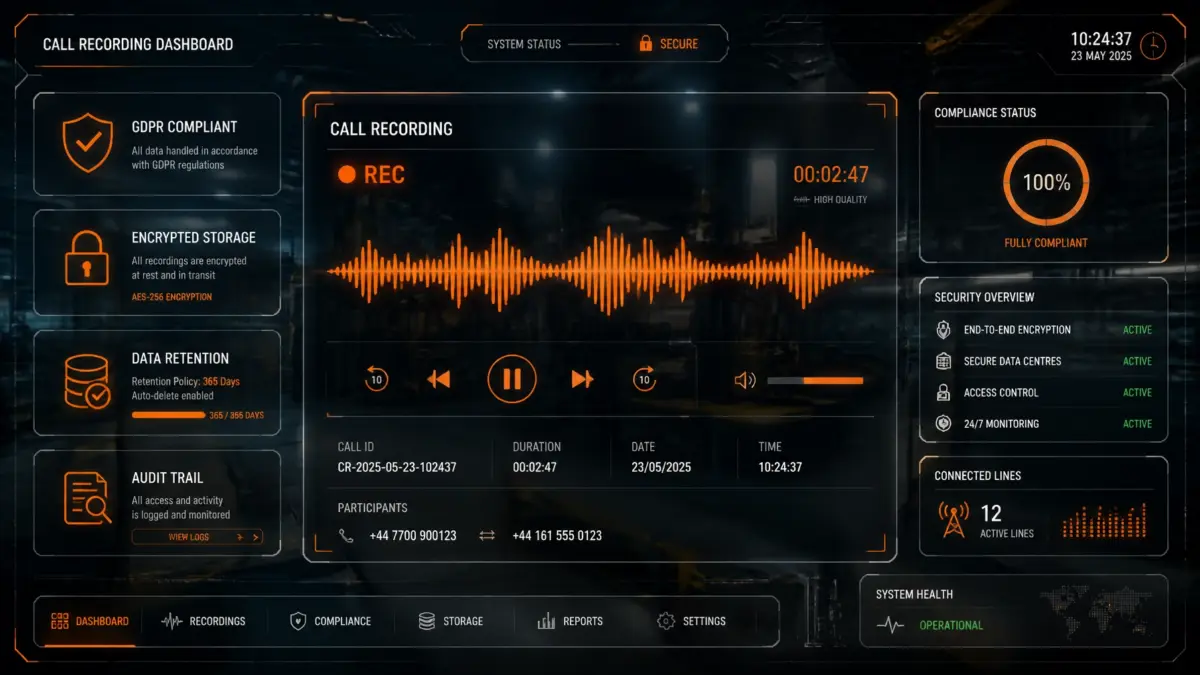
- Encrypted & Secure: Our infrastructure is built to the same standards as our Surveillance Guardian platform. Your data is encrypted, backed up, and protected.
- AI Transcription: Instead of listening to 20 minutes of audio to find the price mentioned, our AI transcribes the call and pulls out the key actions. Because this is built-in, you can easily audit what was agreed without the manual graft.

The "Bloke in a Van" vs. The Professional Firm
Beyond the law, there’s the brand. When an engineer calls a customer from their personal mobile, it shows an 07… number. It feels informal. If that call isn't recorded and a dispute arises, the customer feels they can push back.
When that same engineer calls through the EM8 HQ app, the customer sees your professional office number. They hear the recording announcement. The entire tone of the interaction shifts to "Professional Contractor." People are less likely to try and "tweak" the truth when they know there’s a record.
Summary Checklist for 2026
If you’re running a trades business today, run through this list:
- Identify your Lawful Basis: Are you relying on Legitimate Interest? (Hint: You probably should be).
- Update your Privacy Policy: Does it mention call recording and how long you keep the files?
- Check your Announcements: Are callers being told they are being recorded before the conversation starts?
- Centralise your Data: Stop recording on individual mobile handsets. It’s a GDPR nightmare.
- Plan for 2027: Don't wait for the analogue switch-off to modernize your phones.
The law isn't there to stop you from protecting your business; it’s there to ensure you do it fairly. By using a system designed for the trades, like VoIP Guardian, you can stop worrying about the "what ifs" and get back to the job at hand.
Ready to professionalize your comms and lock down your compliance? Start a conversation with the Engineer M8 team today.